What Are Ergonomic Casters?
By utilizing ergonomic casters, your company gains multiple advantages, including reduced injuries, increased savings, and enhanced productivity. In fact, you’re much more likely to keep ergonomic initiatives when you invest in ergonomic casters.
However, on the thousands of on-site visits we’ve had with our clients, we have noticed that initially they might think of casters like batteries or light bulbs, that is, like commodities. It is true that some horrible casters are commodities. They provide very few ergonomic benefits.
Using these casters in a quality business operation is a huge mistake. Employees are injured daily, and there is a huge cost associated with the injuries to these poor employees. Ergonomic casters literally make the difference between injury and productivity.
So, ask yourself this question, “Are my casters ergonomic casters, or are they putting my employees in danger?”
In this article, we’ll show you how you can tell the difference between good and horrible ergonomic casters before you buy them.
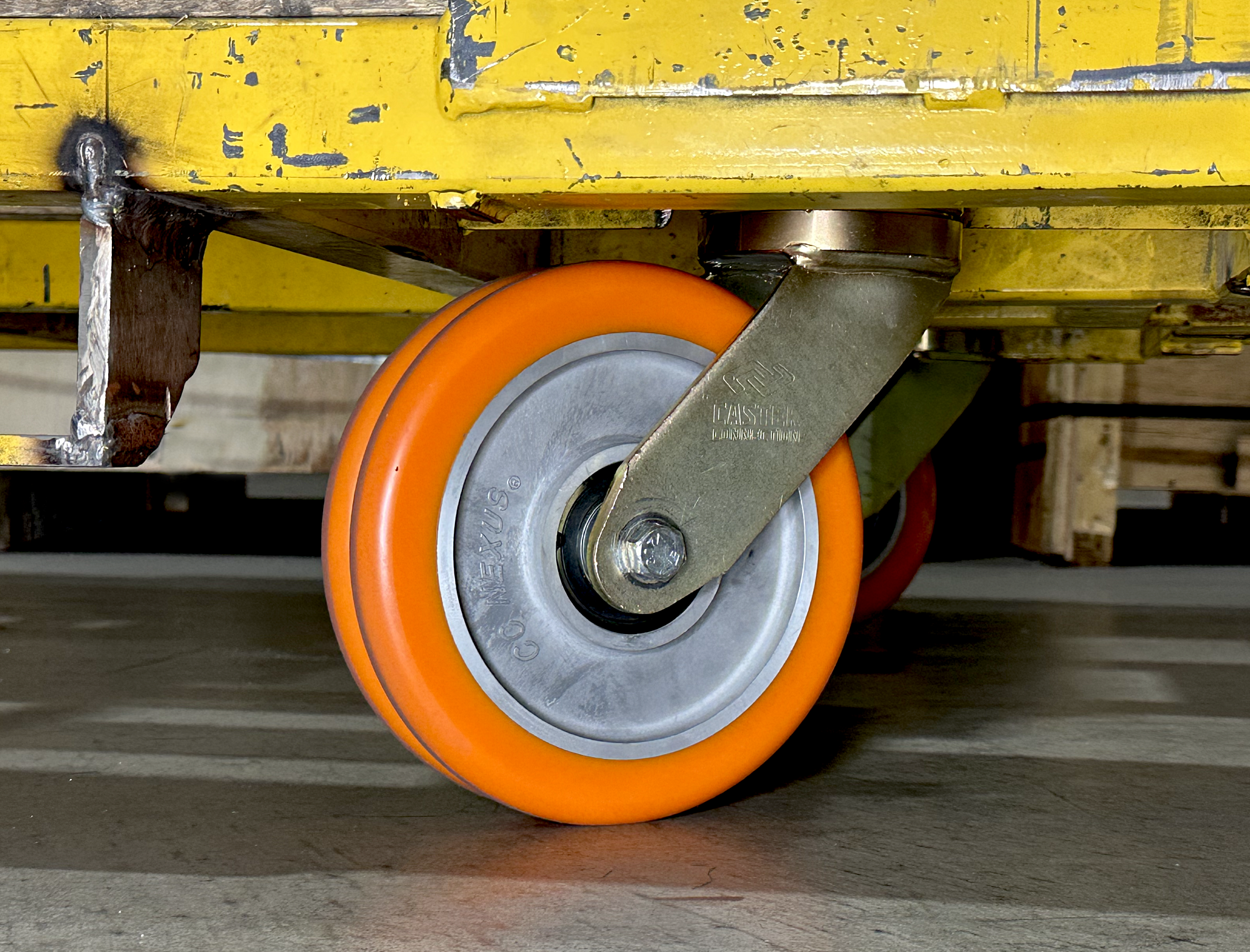
8" CC Nexus Kingpinless Swivel Caster with Extended Swivel Lead - 4" X 4-1/2" top plate
SKU: CC-2215-800200-40-T1
-
- Overall Height
- 9-1/2"
- Wt. Capacity
- 1,750 lbs.
- Wheel Width
- 2"
- Wheel Diameter
- 8"
8" CC Nexus Kingpinless Swivel Caster - 4" X 4-1/2" top plate
SKU: CC-2115-800200-40-T1
-
- Overall Height
- 9-1/2"
- Wt. Capacity
- 1,750 lbs.
- Wheel Width
- 2"
- Wheel Diameter
- 8"
8" CC Nexus Maintenance-Free Swivel Caster - 4" X 4-1/2" top plate
SKU: CC-3115-800200-40-T1
-
- Overall Height
- 9-1/2"
- Wt. Capacity
- 1,750 lbs.
- Wheel Width
- 2"
- Wheel Diameter
- 8"
6" CC Apex Kingpinless Swivel Caster
SKU: CC-2110-600200-40-T1
-
- Overall Height
- 7-1/2"
- Wt. Capacity
- 1,000 lbs.
- Wheel Width
- 2"
- Wheel Diameter
- 6"
6" CC Apex Extended-Lead Kingpinless Swivel Caster
SKU: CC-2210-600200-40-T1
ALT-SKU: CCAPEX-6S-KP-EXT
-
- Overall Height
- 7-1/2"
- Wt. Capacity
- 1,000 lbs.
- Wheel Width
- 2"
- Wheel Diameter
- 6"
6" CC Peak Maintenance-Free Swivel CC Apex Caster
SKU: CC-3110-600200-40-T1
ALT-SKU: CCAPEX-6S-EMF
-
- Overall Height
- 7-1/2"
- Wt. Capacity
- 1,000 lbs.
- Wheel Width
- 2"
- Wheel Diameter
- 6"
8" CC Apex Kingpinless Swivel Caster
SKU: CC-2110-800200-40-T1
-
- Overall Height
- 9-1/2"
- Wt. Capacity
- 1,200 lbs.
- Wheel Width
- 2"
- Wheel Diameter
- 8"
8" CC Apex Kingpinless Swivel Caster with Extended Swivel Lead
SKU: CC-2210-800200-40-T1
-
- Overall Height
- 9-1/2"
- Wt. Capacity
- 1,200 lbs.
- Wheel Width
- 2"
- Wheel Diameter
- 8"
8" CC Peak Maintenance-Free Swivel CC Apex Caster w/ Extended Swivel Lead
SKU: CC-3210-800200-40-T1
ALT-SKU: CCAPEX-8S-EMF-EXT
-
- Overall Height
- 9-1/2"
- Wt. Capacity
- 1,200 lbs.
- Wheel Width
- 2"
- Wheel Diameter
- 8"
ERGONOMIC CASTER WHEEL QUALITIES:
CASTER WHEEL MATERIAL
The material of the caster is incredibly important. Imagine a wheel made of Jell-O versus a wheel made of stone.
Each wheel would work differently. You’re not going to find wheels made of these materials, but the extremes illustrate how a variation in a formulation can change the qualities of the caster wheel material.
That’s really all we’re looking for, qualities, and the vast majority of the time, nylon and polyurethane provide us the features we need, although there are other materials as well.
There are also huge differences in qualities and formulations of polyurethane and nylon. So, what qualities differ between specific formulations of materials of nylon and polyurethane?
DUROMETER
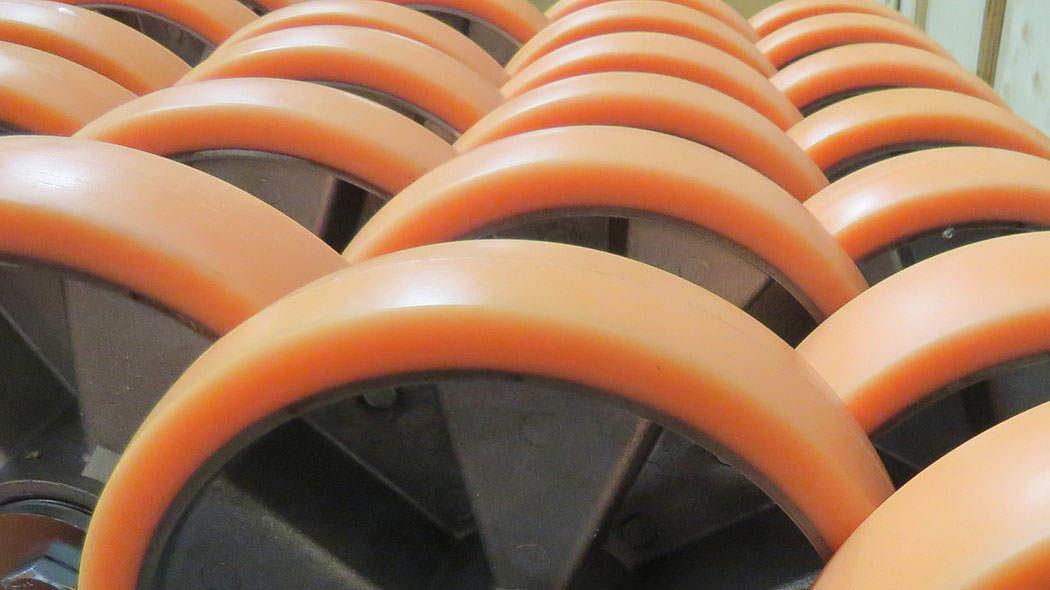
Durometer is the measure of how hard the material is. In general, you want your material to be as hard as possible because the harder the material, the easier you can roll your cart.
Keep in mind that there are a bunch of other factors that will affect your ability to roll your cart. You can’t just go buy a caster made of solid steel and expect it to perform well without a little thought first.
Some of the factors that will limit your ability to use a hard wheel include the amount of debris, the presence of impediments (bumps, potholes, lips), the need to preserve the floor (a hard wheel beats up your floors), the need for silence and grip, and the need for variety of applications (push/pull and towlines).
In other words, we increase our durometer as high as we can, while maintaining the best qualities we can for the unique application.

REBOUND RESILIENCE
So, if we could increase the durometer but still have some of the qualities mentioned above, we would have an ideal caster wheel.
That’s where rebound resilience comes into play. Rebound resilience is essentially the polyurethane’s ability to bounce or spring off of the ground. You can test this very easily as you can see here.
Rebound resilience separates a good caster from a horrible caster. You can have a lower durometer to navigate over debris and still be used in towlines, but still increased push/pull because the rebound resilience springs the wheel off of the floor.
CASTER WIDTH AND DIAMETER
Basically, the larger the diameter, the easier your cart rolls. You’re only limited by the dimensions of your carts and space available in your facility.
The width is adjusted according to the amount of weight that your cart normally carries. The more weight you need, the wider your caster will be, so basically you need to play with each caster diameter and width for the weight and size restrictions found with each application.

CASTER SHAPE AND DESIGN
The shape of the tread surface greatly affects how ergonomic your caster will be. When you have a rounder caster tread, your wheel touches less of the surface.
This is the case only when you have no weight on the wheels. When you add weight, the wheel begins to compress and flatten.
If you add too much weight, the tread will flatten completely, and then you have to rely on the quality of the material (polyurethane, nylon, etc.), and not the tread shape.
For this reason, a rounded or donut tread is a more ergonomically designed caster for weights around 2,500 and below, depending on the durometer.
Weights above this with a donut tread are normally compressed to the point that you no longer can take advantage of the smaller surface area for easier pushing and pulling, unless you adjust the diameter and/or durometer.
Because of this, you can have ergonomic casters with a flatter tread at higher weights, such as the CC Stark.
The other way you can modify the caster tread is by splitting it, that is, to have two thin wheels used in place of one integral tread. This splitting is referred to as a split tread.
The split tread has only come around in the last few years. The problem with the split tread is that you have a very difficult time utilizing the rounded tread, because you have split right down the center of the donut tread.
This means that you get more friction and that you have higher push/pull. For this reason, an “integral” tread is better for ergonomics. A great example of a fantastic ergonomic caster with an integral donut tread is the CC Apex.

ERGONOMIC RIG QUALITIES:
CASTER LEAD
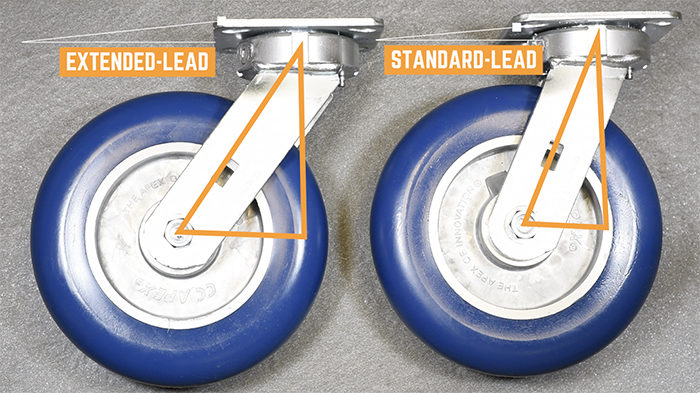
For ergonomics, you want an extended lead. Lead is essentially the angle of the fork. An extended lead is a sharp angle of the fork.
This allows the caster to move much more efficiently and effortlessly, when the wheel is at a variety of different angles. So, this one is easy; get an extended lead.
CASTER RIG QUALITY AND DESIGN
The quality and design of the bearing is incredibly important for how smooth the rig is. Multiple types of bearings allow the rig to move smoothly in different directions. Thrust and roller bearings are great options for an ergonomic caster.
There are many qualities of rigs that you should look at, but you need a maintenance-free/sealed rig if you want to have a quality ergonomics experience.
A sealed rig keeps dirt, salt, ice, and everything else out of the bearings and allows you to push your cart easily for many years.
If the bearings get debris into them, the rig will not move well anymore. There are other qualities of a rig that affect longevity, but the lead and bearings (sealed) are the most important for ergonomics. A perfect example of this type of a rig is the CC Peak.

Need help with implementing ergonomic casters?
Get Rolling with Caster Connection →
FAQ: Ergonomic Casters, Push/Pull Force, and Safer Cart Movement
How can I reduce push force requirements on warehouse carts?
Reducing push force starts with choosing casters that lower rolling resistance and help the cart start moving more easily. Wheel material, wheel diameter, tread design, bearing quality, caster alignment, and swivel performance all affect how much force an employee needs to move a cart.
In many warehouse applications, upgrading from commodity casters to high-performance ergonomic casters can make a noticeable difference. Larger diameter wheels, precision bearings, and high-quality polyurethane tread materials can help carts roll more smoothly while reducing the effort required to start, turn, and maintain movement.
It is also important to look beyond the caster itself. Cart weight, load distribution, floor conditions, debris, cart handle height, and travel distance all influence push force. If employees are struggling to move carts, the best solution is often a full mobility review rather than a one-for-one caster replacement.
How do I choose casters for carts that frequently start and stop under load?
Carts that frequently start and stop under load need casters designed for high starting force, repeated movement, and dynamic stress. Starting a loaded cart from a stopped position often requires more force than keeping it moving, so low rolling resistance and strong swivel performance are especially important.
Look for casters with durable wheel materials, high-quality bearings, and a rig design that can handle repeated starts, stops, and turns without binding or wearing prematurely. Polyurethane ergonomic wheels are often a strong choice because they can provide durability, floor protection, and smoother rolling performance.
For heavier carts, make sure the caster is rated for the actual loaded condition and not just the empty cart weight. Load distribution, shock loading, and floor transitions should all be considered when selecting a caster for frequent start/stop movement.
How do I choose casters that minimize rolling resistance over long distances?
To minimize rolling resistance over long distances, focus on wheel material, wheel diameter, tread shape, bearing type, and floor compatibility. In general, larger wheels roll more easily than smaller wheels, and high-performance polyurethane wheels can offer a strong balance of durability, floor protection, and efficient movement.
Long-distance cart movement also increases the importance of caster alignment and tracking. If the caster setup causes the cart to drift, shimmy, or require constant correction, employees will use more energy over time. The right swivel and rigid caster combination can help the cart track more predictably and reduce operator fatigue.
For long routes, avoid choosing casters based only on load capacity. A caster may be strong enough to hold the weight but still create unnecessary rolling resistance. The best ergonomic solution should make the cart easier to start, easier to keep moving, and easier to control over the full travel path.
How do I choose ergonomic casters to reduce push/pull force for employees?
To choose ergonomic casters, start by evaluating how employees actually move the cart. Consider the loaded weight, travel distance, floor surface, frequency of use, turning requirements, and whether the cart is pushed, pulled, towed, or repositioned throughout the day.
Important ergonomic caster features include low rolling resistance, smooth swivel action, durable wheel tread, proper wheel diameter, and strong performance under load. High-performance polyurethane wheels, such as those used in CC Apex® and CC Nexus™, are often selected for ergonomic applications because they can help reduce push/pull force while still performing well in industrial environments.
For the best result, ergonomic caster selection should be based on the full application rather than a single product feature. The goal is to reduce the effort required to start, stop, turn, and control the cart while maintaining durability, safety, and floor protection.
How do I improve ergonomics of existing carts without replacing the whole cart?
In many cases, you can improve cart ergonomics without replacing the entire cart by upgrading the casters and reviewing the overall cart setup. Replacing worn or poorly matched casters with ergonomic caster wheels can reduce push/pull force, improve maneuverability, and make the cart easier to control.
Start by inspecting the current casters for flat spots, debris buildup, worn bearings, swivel issues, uneven tread wear, or incorrect wheel material. Then evaluate whether the cart would benefit from larger wheels, better bearings, a different tread material, swivel locks, brakes, or a different caster configuration.
It is also helpful to review handle height, load placement, floor conditions, and travel routes. A caster upgrade can make a major improvement, but the best ergonomic results usually come from treating the cart as a full mobility system.
How do I minimize operator strain when moving high-capacity carts?
High-capacity carts require special attention because heavier loads increase the force needed to start, stop, turn, and control the cart. To minimize operator strain, choose casters with low rolling resistance, high load capacity, strong swivel performance, and wheel materials that match the floor and duty cycle.
Larger diameter wheels can help reduce rolling effort, while high-performance polyurethane tread can improve ride quality, floor protection, and durability. Kingpinless rigs, precision bearings, and ergonomic wheel designs may also help improve movement under heavy loads.
For very heavy carts, it is important to evaluate whether the cart should be moved manually at all. If push/pull force is too high, a powered assist, tugger system, ergonomic redesign, or custom mobility solution may be needed. The safest solution is one that protects both the employee and the equipment.
What are the key traits of high-performance ergonomic caster wheels?
High-performance ergonomic caster wheels are designed to reduce the effort required to move carts while still delivering industrial durability. The most important traits include low rolling resistance, smooth starting force, reliable swivel performance, vibration reduction, floor protection, and long service life.
A good ergonomic caster wheel should help the cart start moving more easily, roll smoothly over the intended floor surface, turn predictably, and reduce the force needed from employees. It should also resist premature wear, debris buildup, flat spotting, and tread damage.
In demanding environments, ergonomic performance should not come at the expense of durability. The best ergonomic caster wheels balance comfort, control, load capacity, and long-term reliability.
How can I optimize caster selection for an ergonomic cart redesign project?
For an ergonomic cart redesign project, begin by defining the real operating conditions. Document the loaded cart weight, travel distance, floor surface, route layout, push/pull frequency, turning requirements, operator feedback, and any current pain points such as noise, vibration, difficult starts, or poor maneuverability.
Next, evaluate the caster system as part of the full cart design. Wheel material, diameter, bearing type, swivel lead, caster placement, handle height, load distribution, and braking requirements all affect ergonomic performance.
A successful redesign should reduce push/pull force, improve control, protect the floor, and maintain durability under real operating conditions. For best results, consider testing different caster options or working with Caster Connection to evaluate the application before finalizing the design.