How to Reduce Meal-Cart Push/Pull Force

How to Reduce Push/Pull Force on a Fully Loaded Meal Cart
A meal cart can seem perfectly manageable in the kitchen and become a very different piece of equipment once it is loaded with trays, beverages, insulated containers, heating equipment, and supplies.

The operator pushes against the handle, but the cart hesitates. The swivel casters do not immediately align. Crossing the kitchen threshold requires extra effort. Turning into the elevator feels harder than traveling down the hallway, and positioning the cart outside a patient or resident room requires repeated corrections.
Over one meal round, those moments may appear minor. Repeated across several carts, floors, meals, and shifts, they can create a persistent ergonomic problem.
Reducing meal-cart push/pull force requires more than installing a caster with sufficient load capacity. The complete mobility system—including the wheel material, wheel diameter, bearings, swivel construction, caster layout, cart frame, load distribution, flooring, route, and maintenance condition—must work together.
CC Apex 6" x 2" Polyurethane Swivel Caster - FASTER CASTER - Online-Only
SKU: FC-CC-1210-600200-40-T1
CC Apex 6" x 2" Polyurethane Rigid Caster - FASTER CASTER - Online-Only
SKU: FC-CC-1010-600200-40-T1
ALT-SKU: CCAPEX-6R
CC Apex 6" x 2" Polyurethane Set of Four Casters
SKU: CC-10/1210-600200-40-T1-SET4
ALT-SKU: CCAPEX-6S/R-set-2s/2r
What Is the Fastest Way to Reduce Meal-Cart Push/Pull Force?
The most effective starting point is to inspect and test the cart under its actual loaded operating conditions.
In many applications, push/pull force can be reduced by:
- Increasing wheel diameter where clearance permits
- Selecting a wheel with lower rolling resistance and appropriate rebound
- Adding or upgrading wheel bearings
- Improving swivel performance
- Correcting caster alignment
- Using a caster configuration that balances turning with directional control
- Repairing damaged cart frames and mounting points
- Removing debris and replacing worn wheels
- Improving load distribution
- Addressing difficult thresholds, floor joints, or elevator gaps
- Adding directional locks, brakes, or powered assistance when appropriate
The correct intervention depends on where and how the cart becomes difficult to move.
Load Capacity and Rollability Are Not the Same Thing
One of the most common mistakes in caster selection is assuming that a caster capable of supporting the cart’s weight will also make the cart easy to move.
Load capacity tells you how much weight the caster is designed to support under specified conditions. It does not automatically tell you:
- How much force is required to start the cart
- How easily the wheels will roll
- How much effort is needed to turn
- Whether the casters will track through a corridor
- How the wheels will cross thresholds
- How much vibration they will transmit
- Whether the brakes will remain accessible
- How the caster will perform after repeated washdown
A fully loaded meal cart can be within the rated capacity of its casters and still require excessive operator effort.
Ergonomic caster selection must consider both capacity and mobility.
The Four Forces That Matter During a Meal Round
Push/pull testing is sometimes reduced to one peak number. In actual meal delivery, employees experience several different mobility demands.

1. Starting Force
Starting force is the effort required to overcome inertia, wheel deformation, bearing resistance, and swivel alignment to initiate movement.
A cart may be especially difficult to start when:
- The wheels have developed flat spots
- Resilient treads are deforming excessively
- Bearings are worn or contaminated
- Swivel casters are pointing in different directions
- The cart has remained stationary under a heavy load
- The floor has a depression or slope
- Brakes are dragging
2. Sustained Rolling Force
Sustained force is the effort required to keep the cart moving after it has started.
It is affected by:
- Wheel material and rebound
- Wheel diameter
- Bearings
- Floor condition
- Load
- Cart alignment
- Travel speed
- Wheel damage
- Debris
- Floor slope
A cart can require a high starting force but roll relatively well once moving—or start acceptably and remain difficult throughout the route.
3. Turning Force
Turning requires the swivel casters to rotate while the wheels and cart change direction. The wheel treads may also scrub against the floor.
Turning demand is influenced by:
- Caster configuration
- Swivel lead
- Swivel-bearing condition
- Cart length and width
- Wheel width
- Tread material
- Load distribution
- Handle position
- Starting wheel orientation
- Turning radius
- Floor friction
Research conducted through The Ohio State University Spine Research Institute compared single-axis force gauges with three-dimensional hand-force measurement during pushing, pulling, and turning. The research reinforces that exertion type, testing pace, force angle, and cart load can affect measurements.
This is why straight-line testing alone may not reveal the most difficult portion of a meal-delivery route.
4. Stopping and Positioning Force
Once a cart rolls more easily, it must still stop and remain controlled.
Stopping and positioning are especially important near:
- Patients and residents
- Doorways
- Elevators
- Ramps
- Serving locations
- Medical equipment
- Dining-room furniture
Any caster change intended to lower rolling resistance should include a review of brakes, directional control, cart stability, and stopping behavior.
Ten Ways to Reduce Push/Pull Force on a Meal Cart
1. Measure the Maximum Loaded Weight
Evaluate the cart at its heaviest expected operating condition—not only when empty.
Include:
- Cart and enclosure weight
- Trays
- Plates and utensils
- Food and beverages
- Heating or refrigeration systems
- Batteries
- Condiment and supply storage
- Accessories
- Equipment added after the cart was originally purchased
Load distribution matters as much as total weight. Heating equipment, batteries, beverage containers, or concentrated tray loads can place more weight over one end of the cart.
Do not assume that each caster carries an equal share. Uneven floors, frame deflection, concentrated loads, and manufacturing tolerances can cause one or more casters to carry disproportionate weight.
2. Use the Largest Practical Wheel Diameter
Larger-diameter wheels generally cross floor joints, thresholds, debris, and elevator gaps more easily than smaller wheels.
OSHA’s hospital ergonomics guidance recommends well-maintained rolling or powered carts with large, low-resistance wheels that can travel over mixed flooring and gaps between elevators and hallways. Review OSHA’s hospital cart guidance.

A larger wheel may reduce the force needed to negotiate obstacles, but it can also affect:
- Overall cart height
- Tray and handle height
- Center of gravity
- Equipment clearance
- Brake access
- Heating or cooling-system clearance
- Fit within cart-washing equipment
Wheel diameter should therefore be increased only after the complete cart has been reviewed.
3. Match the Wheel Material to the Load and Floor
Wheel material affects rolling resistance, noise, vibration, floor protection, capacity, and durability.
In general, harder wheels tend to deform less and may roll more easily on smooth, hard floors. However, they may also transmit more sound and vibration into the cart.
Softer wheels may provide quieter, more cushioned movement, but excessive deformation can increase rolling resistance and turning effort.
High-rebound resilient wheels can help balance these competing requirements in some healthcare applications. The appropriate tread formulation depends on:
- Maximum load
- Floor surface
- Wheel diameter
- Movement frequency
- Noise requirements
- Cleaning chemicals
- Temperature
- Time spent stationary
- Desired service life
The objective is not to choose the hardest or softest wheel. It is to select a wheel that retains its shape under load while providing the required cushioning, floor protection, and rolling performance.
4. Evaluate the Wheel Bearings
A wheel without an appropriate bearing may create unnecessary friction between the wheel bore and axle. Worn, corroded, contaminated, or damaged bearings can also make a cart harder to move.
When selecting a bearing, consider:
- Cart load
- Wheel speed
- Travel frequency
- Manual or powered movement
- Washdown exposure
- Cleaning chemicals
- Food residue
- Corrosion
- Maintenance practices

Precision or appropriately selected full-bearing wheels can improve rolling performance, but the bearing must remain compatible with the sanitation environment.
OSHA’s nursing-home ergonomics guidance recommends full-bearing wheels made from a material suited to the facility’s floors when carts are used to move food trays, supplies, and medications. Review OSHA’s nursing-home guidance.
5. Inspect Swivel Performance
When a swivel caster changes direction, the rig must rotate around its swivel section before the wheel can trail behind the pivot point.
Several conditions can increase swivel effort:
- Worn swivel bearings
- Contamination or corrosion
- Excessive load
- A damaged or distorted rig
- Insufficient swivel lead
- Loose mounting
- Wheel interference
- Mismatched casters
- Cart-frame misalignment
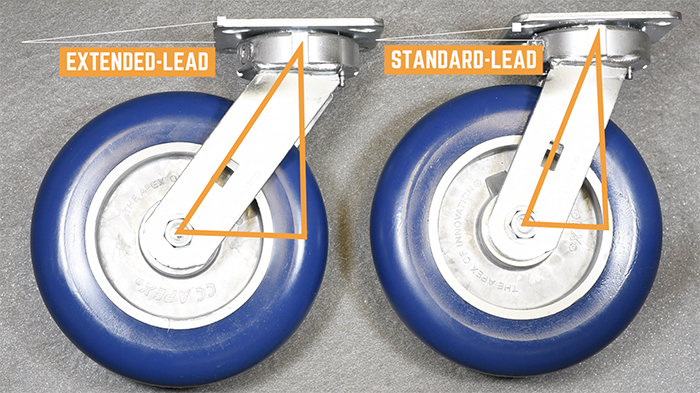
Swivel lead is the horizontal distance between the caster’s vertical swivel axis and the wheel axle. That geometry influences how readily the caster responds to a change in direction.
More swivel lead can improve steering in some applications, but it also affects turning clearance, stability, and the space required for the caster to rotate. Swivel geometry must be matched to the cart rather than treated as an isolated specification.
6. Choose the Right Caster Configuration
Caster placement can make an otherwise appropriate wheel feel difficult to use.

Common configurations include:
Two swivel and two rigid casters
This arrangement generally provides predictable tracking in long corridors. The cart usually turns from the swivel-caster end.
Four swivel casters
Four swivel casters can make lateral positioning and tight turns easier. However, the cart may wander or require frequent corrections during long, straight travel.
Four swivel casters with directional locks
Directional locks can temporarily make selected swivel casters track like rigid casters. This arrangement may provide maneuverability in serving areas and greater control in long corridors.
Specialty six-caster or center-wheel configurations
Long meal carts may use six casters or a raised center pair to improve pivoting. These layouts require careful attention to load distribution, stability, floor conditions, and threshold performance.
The correct pattern depends on the cart’s dimensions, route, turning radius, elevator size, handle location, and operator workflow.
7. Check Alignment and Cart-Frame Condition
A new caster cannot fully compensate for a damaged cart.
Inspect the frame and mounting points for:
- Bent caster plates
- Distorted mounting surfaces
- Loose fasteners
- Cracked welds
- Frame deflection
- Out-of-square construction
- Uneven caster heights
- Mismatched wheel diameters
- Casters that do not maintain floor contact
- Brakes rubbing against wheels
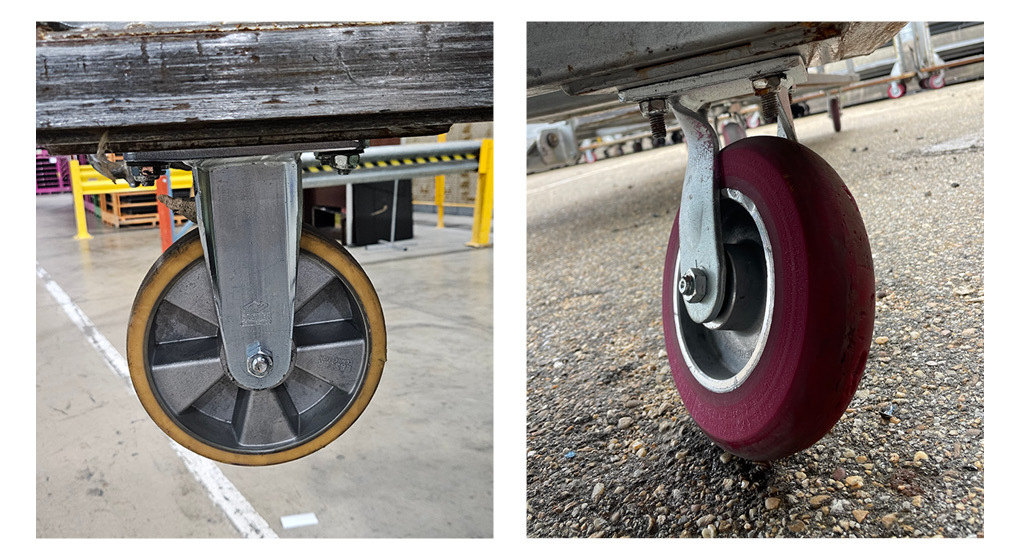
If rigid casters are not aligned, they can work against each other and cause the cart to pull to one side. If the frame flexes under load, caster alignment and weight distribution may change as the cart moves.
Before replacing the caster specification, confirm that the cart itself is structurally sound.
8. Address Floors, Thresholds, and Elevator Gaps
Sometimes the caster is only part of the problem.
Document every surface along the meal-delivery route:
- Kitchen flooring
- Tile and grout joints
- Sheet vinyl
- Luxury vinyl tile
- Terrazzo
- Carpet
- Door thresholds
- Elevator gaps
- Expansion joints
- Ramps
- Floor drains
- Damaged or uneven areas
Look for locations where operators slow down, pull harder, strike the cart against an obstacle, or reposition their hands.
Possible interventions can include:
- Repairing damaged flooring
- Reducing abrupt transitions
- Maintaining elevator thresholds
- Changing the route
- Increasing wheel diameter
- Selecting a more resilient tread
- Adjusting cart speed
- Eliminating unnecessary stops or turns
Testing only on the smoothest kitchen floor will not represent the complete task.
9. Maintain the Casters
Push/pull force can increase gradually as casters wear. Because the change occurs over time, employees may compensate until difficult movement becomes accepted as normal.
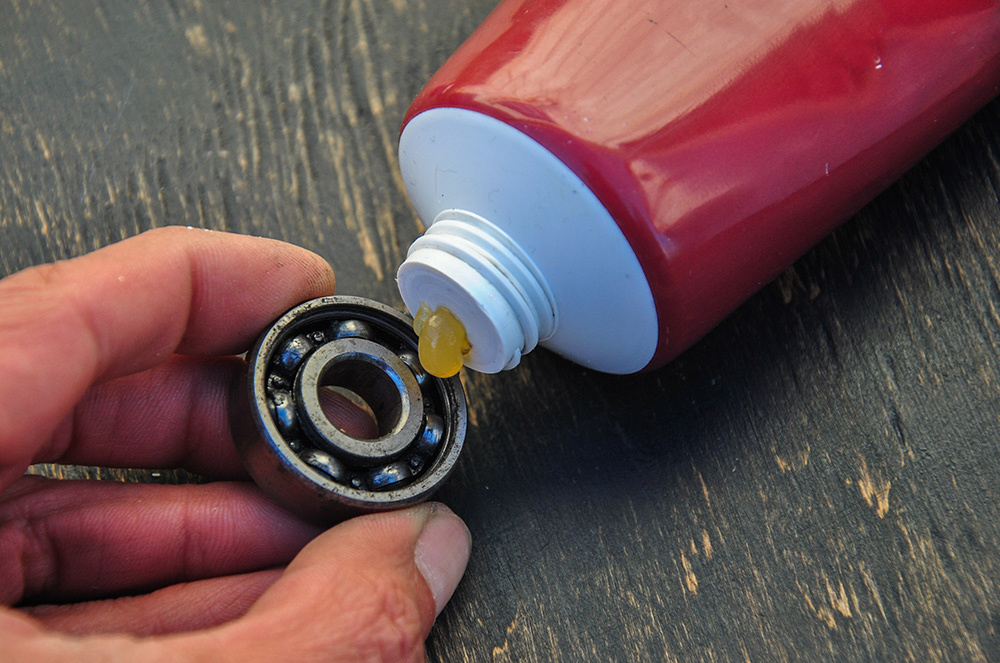
Inspect for:
- Hair, string, plastic, or debris around axles
- Food residue
- Flat spots
- Wheel wobble
- Cracked or separated tread
- Damaged wheel bearings
- Corroded swivel sections
- Loose mounting hardware
- Bent rigs
- Dragging brakes
- Mismatched replacement wheels
- Excessive swivel play
Maintenance schedules should reflect cart usage, cleaning exposure, load, and operating conditions.
A cart that repeatedly needs more force should be removed for inspection instead of simply becoming “the difficult cart.”
10. Review Handles and Work Practices
Even a free-rolling cart can create ergonomic challenges if the operator cannot apply force from a stable posture.
OSHA recommends vertical handles with some horizontal adjustability so employees can push at approximately elbow height and shoulder width. The agency also recommends balancing the load, keeping within cart restrictions, maintaining visibility, and pushing rather than pulling when possible.
Handle and cart-design considerations include:
- Handle height
- Handle width
- Grip shape
- Hand clearance
- Wrist posture
- Employee height differences
- Visibility over or around the cart
- Cart direction
- Access to brakes and controls
Whenever possible, employees should use the designated handle rather than pushing against doors, tray racks, or the side of the cart.
Work-practice changes should support a properly designed cart—not be used to compensate for worn or unsuitable casters.
Common Symptoms and Potential Corrections
Cart behavior | Conditions to investigate | Potential intervention |
Difficult to start | Flat spots, tread deformation, brake drag, bearing resistance | Inspect brakes and bearings; review load and wheel material |
Rolls hard throughout route | Small wheels, unsuitable tread, bearing friction, floor resistance | Evaluate larger wheels, higher-rebound tread, and appropriate bearings |
Difficult to turn | Swivel wear, poor caster layout, wide tread, uneven load | Review swivel rig, lead, configuration, and load placement |
Pulls to one side | Misalignment, uneven wear, mismatched casters, sloped floor | Inspect frame, rigid-caster alignment, wheel size, and floor |
Stops abruptly at elevator | Small diameter, excessive gap, hard tread | Review wheel diameter, tread resiliency, speed, and transition |
Requires repeated correction | Four-swivel layout, poor directional control | Consider directional locks or a different caster configuration |
Becomes harder after cleaning | Water or chemicals entering bearings, corrosion, residue | Review seals, materials, cleaning procedure, and lubrication |
Easy empty but difficult loaded | Insufficient capacity margin, tread deformation, frame flex | Test at maximum load and review the complete cart structure |
How to Measure Meal-Cart Push/Pull Force
A force gauge can help compare an existing caster system with a proposed replacement, but testing must be controlled.
Caster Connection’s work with The Ohio State University Spine Research Institute has demonstrated that measurements can be affected by gauge angle, movement speed, acceleration, load, operator behavior, surface conditions, and exertion type.
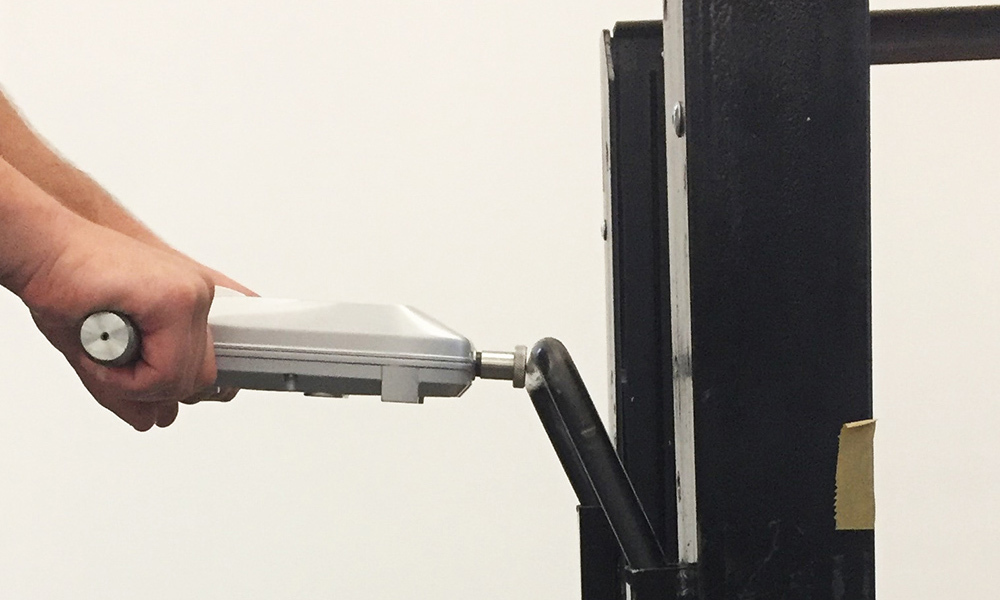
For a useful before-and-after comparison:
- Use the same cart.
- Use the same representative load.
- Test on the same section of floor.
- Mark the same starting and stopping points.
- Use the same handle or gauge attachment point.
- Maintain a consistent gauge angle.
- Use a consistent movement speed.
- Use the same operator when practical.
- Repeat each measurement several times.
- Measure starting, sustained, and turning forces separately.
- Record caster orientation at the start of each trial.
- Document temperature and floor condition.
- Test thresholds and elevator transitions separately.
- Capture both objective measurements and operator observations.
Learn more about accurately measuring push/pull force.
A single peak-force number should not be treated as a complete ergonomic assessment. Facilities should interpret force data in the context of the task, workforce, frequency, distance, posture, route, and accepted ergonomic assessment method.
What Should Be Measured Before and After a Caster Change?
A controlled meal-cart trial should capture more than “it feels easier.”
Recommended measures include:
- Maximum loaded weight
- Starting force
- Sustained rolling force
- Turning force
- Stopping behavior
- Threshold impact
- Elevator-gap performance
- Travel time
- Number of operators required
- Directional control
- Brake performance
- Noise
- Vibration
- Operator feedback
- Cleaning compatibility
- Wheel and tread wear
- Maintenance frequency

Using the same conditions before and after an intervention helps determine whether the change produced a meaningful improvement.
When Manual Mobility May No Longer Be Appropriate
Caster improvements can reduce rolling and turning resistance, but they cannot eliminate the physical demands of every application.
A powered or power-assisted meal cart may need to be evaluated when the operation involves:
- Very heavy loads
- Long travel distances
- Frequent ramps or slopes
- Repeated movement throughout a shift
- High starting or turning forces after caster improvements
- Difficult stopping requirements
- Multiple employees needed to move one cart
- Operators working in awkward postures
- Routes with frequent obstacles
OSHA’s hospital guidance specifically identifies rolling or powered carts as possible controls for moving heavy equipment.
If a fully loaded meal cart routinely requires two employees, abrupt body movements, or significant leaning to start or turn, that behavior should be treated as a signal for an ergonomic review—not normalized as part of the job.
Frequently Asked Questions About Meal-Cart Push/Pull Force
Why is a meal cart easy to move when empty but difficult when loaded?
The additional load increases wheel deformation, bearing load, swivel resistance, floor contact, and the force needed to start, turn, and stop the cart. It may also cause the cart frame to flex or distribute weight unevenly.
What caster wheel rolls most easily?
There is no single wheel that rolls best in every application. Harder wheels often deform less on smooth floors, while high-rebound resilient wheels may provide a better balance of rollability, noise reduction, and floor protection. Load, diameter, bearings, floor, and duty cycle must be considered together.
Will larger casters make a meal cart easier to push?
Often, but not automatically. Larger wheels generally cross gaps and obstacles more easily. They may also change cart height, center of gravity, clearance, and brake access.
Can softer wheels reduce push force?
Not necessarily. Softer wheels may reduce noise and vibration, but excessive tread deformation can increase rolling resistance. Resilience and rebound are just as important as tread hardness.
Why are four swivel casters difficult to control?
All four casters can rotate independently, which may cause the cart to wander during long, straight travel. Directional locks or a two-rigid, two-swivel configuration may improve tracking, depending on the route.
Should meal carts be pushed or pulled?
OSHA generally recommends pushing equipment rather than pulling when possible. The task should still be evaluated for handle design, visibility, route, force, posture, and control. Tight positioning may occasionally require pulling, but it should not compensate for a poorly performing cart.
Can casters reduce the number of people required to move a meal cart?
An appropriately designed caster system may reduce the effort required to start, roll, and turn a cart. Whether one-person movement is appropriate must be confirmed through controlled testing and the facility’s safety and ergonomics review.
How often should meal-cart casters be inspected?
Inspection frequency should reflect usage, load, washdown, cleaning chemicals, route conditions, and maintenance history. High-use carts should be inspected often enough to identify debris, wear, corrosion, brake problems, and increased rolling resistance before performance becomes unacceptable.
Make the Fully Loaded Cart the Standard
A meal cart should be evaluated in the condition that matters most: fully loaded, on its actual route, during a normal meal round.
Caster capacity is only the beginning. Wheel diameter, tread resiliency, bearings, swivel design, caster configuration, alignment, flooring, handles, brakes, cleaning exposure, and maintenance all influence the force an employee must apply.
The right solution should help the cart:
- Start predictably
- Roll efficiently
- Turn with control
- Cross thresholds smoothly
- Track through corridors
- Stop safely
- Operate quietly
- Withstand the healthcare environment
Explore casters for meal-delivery carts and Caster Connection’s medical cart caster solutions.
Are Your Meal Carts Too Difficult to Push or Turn?
Complete a complimentary Caster Needs Evaluation
Take the guesswork out of meal-cart mobility. Request your Caster Needs Evaluation and develop a practical plan for easier, quieter, and more controlled meal rounds.