Heavy Equipment Logistics Facility Reduces Industrial Cart Noise by Approximately 40 dB with CC Apex HD Casters

See how a heavy equipment manufacturer's parts logistics operation reported an approximately 40 dB reduction in industrial dumpster noise after testing CC Apex HD heavy-duty polyurethane casters.
How Caterpillar Reduced Industrial Dumpster Noise by Approximately 40 dB with CC Apex HD Casters
At a heavy equipment logistics operation, industrial dumpsters used inside the facility generated excessive rolling noise that disrupted the work environment. After reviewing comparable noise-reduction applications, Caster Connection recommended a trial of CC Apex HD heavy-duty polyurethane casters. The result was a reported noise reduction of approximately 40 dB and an ongoing retrofit program that continues to improve the performance of additional carts.
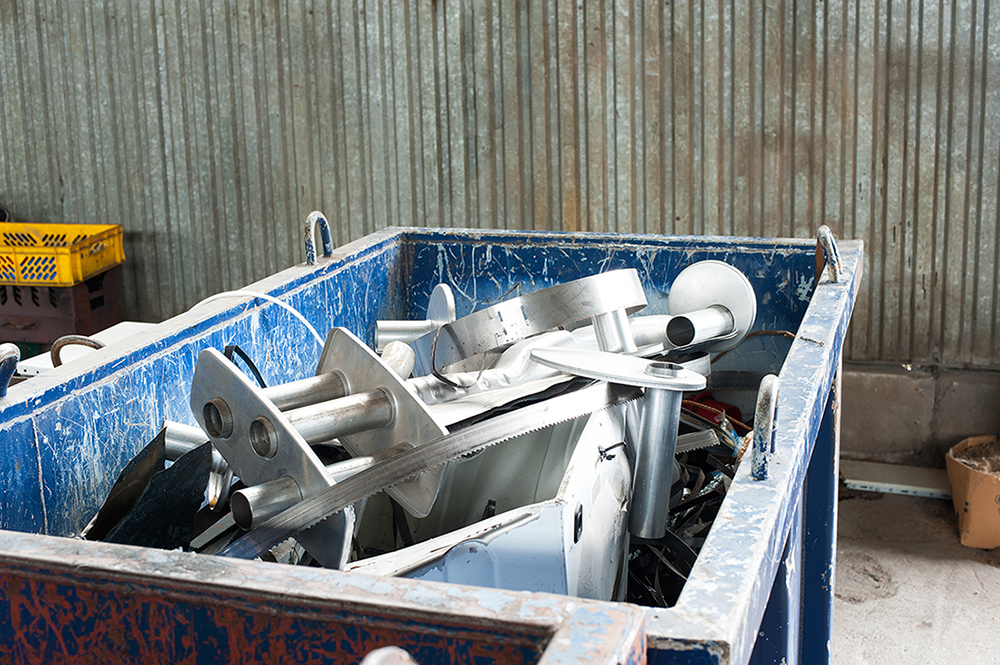
In this case study we will explore how an application-specific caster trial helped create a quieter material-handling environment at a heavy equipment logistics facility.
Case Study Overview
Customer: Global heavy equipment manufacturer’s parts logistics operation
Industry: Heavy equipment parts logistics and industrial material handling
Application: Mobile industrial dumpsters used inside the facility
Primary challenge: Excessive cart noise during normal indoor movement
Recommended products:
- CC-6120-800300-40-T2 — 8-inch x 3-inch CC Apex HD Kingpinless Swivel Caster
- CC-1020-800300-40-T2 — 8-inch x 3-inch CC Apex HD Rigid Caster
Trial configuration: Two swivel casters and two rigid casters
Reported result: Approximately 40 dB reduction in cart noise during the facility trial
Ongoing outcome: Continued monthly purchases to retrofit additional industrial dumpsters
The Customer: Global Heavy Equipment Manufacturer’s Logistics Operation
The customer is part of a global heavy equipment organization with manufacturing, logistics, distribution, service and related operations. Within that network, supply chain and logistics teams are responsible for helping ensure that materials and components reach the people and processes that need them. This work involves managing complex supply-chain processes so teams have the necessary materials when and where they are needed.
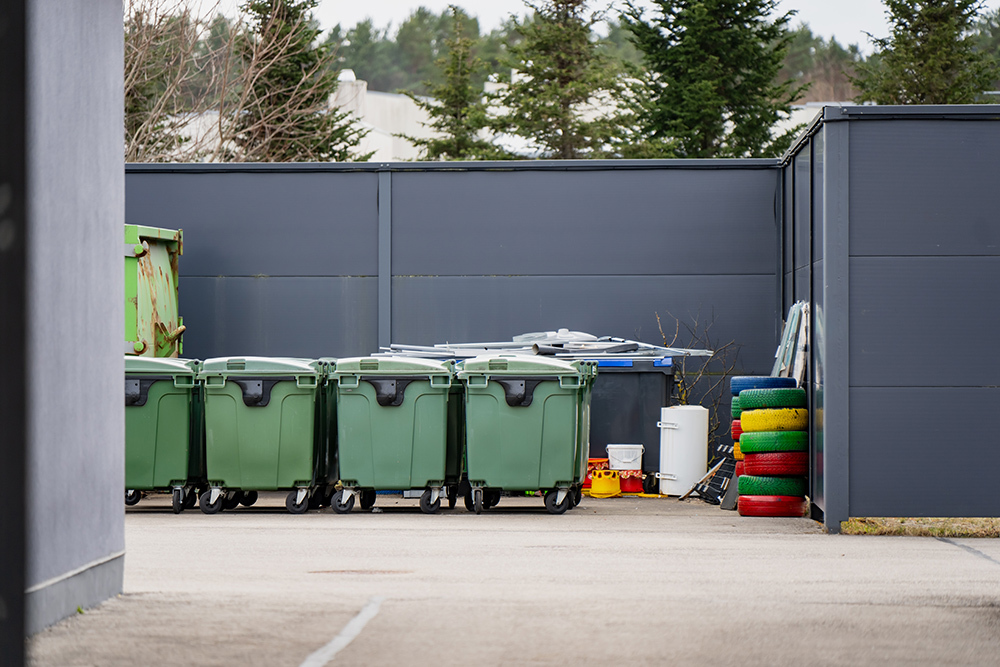
At the logistics operation featured in this case study, mobile industrial dumpsters were used to transport or collect materials inside the facility. These carts performed an important material-handling function, but the caster setup created a persistent problem: the carts were excessively loud while rolling indoors.
In an industrial logistics environment, mobile dumpsters, scrap carts, material-handling carts and waste containers may travel repeatedly across concrete floors. Although the cart structure and load attract much of the attention, the wheels and casters form the only interface between the mobile equipment and the floor.
That interface can significantly affect:
- Rolling noise
- Vibration
- Shock transmission
- Floor protection
- Cart maneuverability
- Push/pull effort
- Caster maintenance
- Overall operator experience
For this facility, noise was not a minor product preference. It was an operational issue that warranted a different approach to industrial cart mobility.
The Challenge: Excessive Noise from Industrial Dumpsters
The industrial dumpsters produced disruptive levels of rolling noise while being moved within the facility.
Common contributors to noisy industrial carts can include:
- Hard wheel materials transmitting impact directly into the cart
- Uneven concrete floors
- Floor joints, cracks, or surface imperfections
- Metal cart construction amplifying vibration
- Loose or worn caster components
- Wheel deformation or tread damage
- Debris embedded in or encountered by the wheels
- Insufficient shock absorption
- A caster specification selected primarily for load capacity rather than overall performance
A wheel may technically support the weight of a loaded dumpster while still producing unacceptable noise, vibration or rolling behavior.
That distinction is central to successful industrial caster selection:
Load capacity determines whether a caster can carry the weight. It does not, by itself, determine whether the cart will move quietly, smoothly or effectively in the actual facility.
The facility team needed an industrial caster capable of supporting a demanding material-handling application while substantially reducing the noise generated as the dumpsters moved across the facility floor.
A Referral Built on Previous Ergonomic Success
The opportunity began through a referral from a contact who had participated in a previous successful Caster Connection ergonomic caster application at another facility within the organization.
That referral gave the team access to more than a product recommendation. It connected the facility with an established application-based process for evaluating industrial mobility problems.
Rather than immediately recommending a standard replacement based only on wheel diameter or mounting dimensions, Caster Connection supplied relevant case studies involving industrial noise reduction. These examples helped the logistics team understand how wheel material, tread design, caster construction and application conditions could influence sound levels.
After reviewing the supporting information, the facility expressed interest in CC Apex HD, Caster Connection’s heavy-duty polyurethane ergonomic caster line.
The Recommended Solution: CC Apex HD
Caster Connection recommended an 8-inch x 3-inch CC Apex HD caster configuration consisting of:
Swivel caster
SKU: CC-6120-800300-40-T2
Configuration: 8-inch x 3-inch CC Apex HD kingpinless swivel caster
Overall height: 10⅛ inches
Rated capacity: 2,700 pounds per caster
Rigid caster
SKU: CC-1020-800300-40-T2
Configuration: 8-inch x 3-inch CC Apex HD rigid caster
Overall height: 10⅛ inches
Rated capacity: 2,700 pounds per caster
CC Apex HD 8" x 3" Polyurethane Kingpinless Swivel Caster - 10-1/8" Overall Height
SKU: CC-6120-800300-40-T2
ALT-SKU: CCAPEXHD-830-S-KP
CC Apex HD 8" x 3" Polyurethane Rigid Caster - 10-1/8" Overall Height
SKU: CC-1020-800300-40-T2
ALT-SKU: CCAPEXHD-830-R
Caster Connection supplied two swivel and two rigid casters for installation and trial.
The two-swivel, two-rigid configuration provided a practical balance between maneuverability and directional control. Swivel casters allow the cart to turn and change direction, while rigid casters help it track more predictably during straight travel.
The selected swivel caster also uses a kingpinless rig design. Kingpinless swivel constructions eliminate the central kingpin found in conventional swivel assemblies and are designed to provide strength, durability and smooth rotation in demanding industrial environments.
Both selected products use an 8-inch-diameter, 3-inch-wide CC Apex HD wheel and carry a published capacity of 2,700 pounds per caster.
Why CC Apex HD Was a Strong Fit
CC Apex HD is Caster Connection’s line of heavy-duty polyurethane ergonomic casters for manual push/pull, towline and automated guided vehicle applications. Depending on the configuration, the line includes capacities ranging from 2,700 to 3,500 pounds.
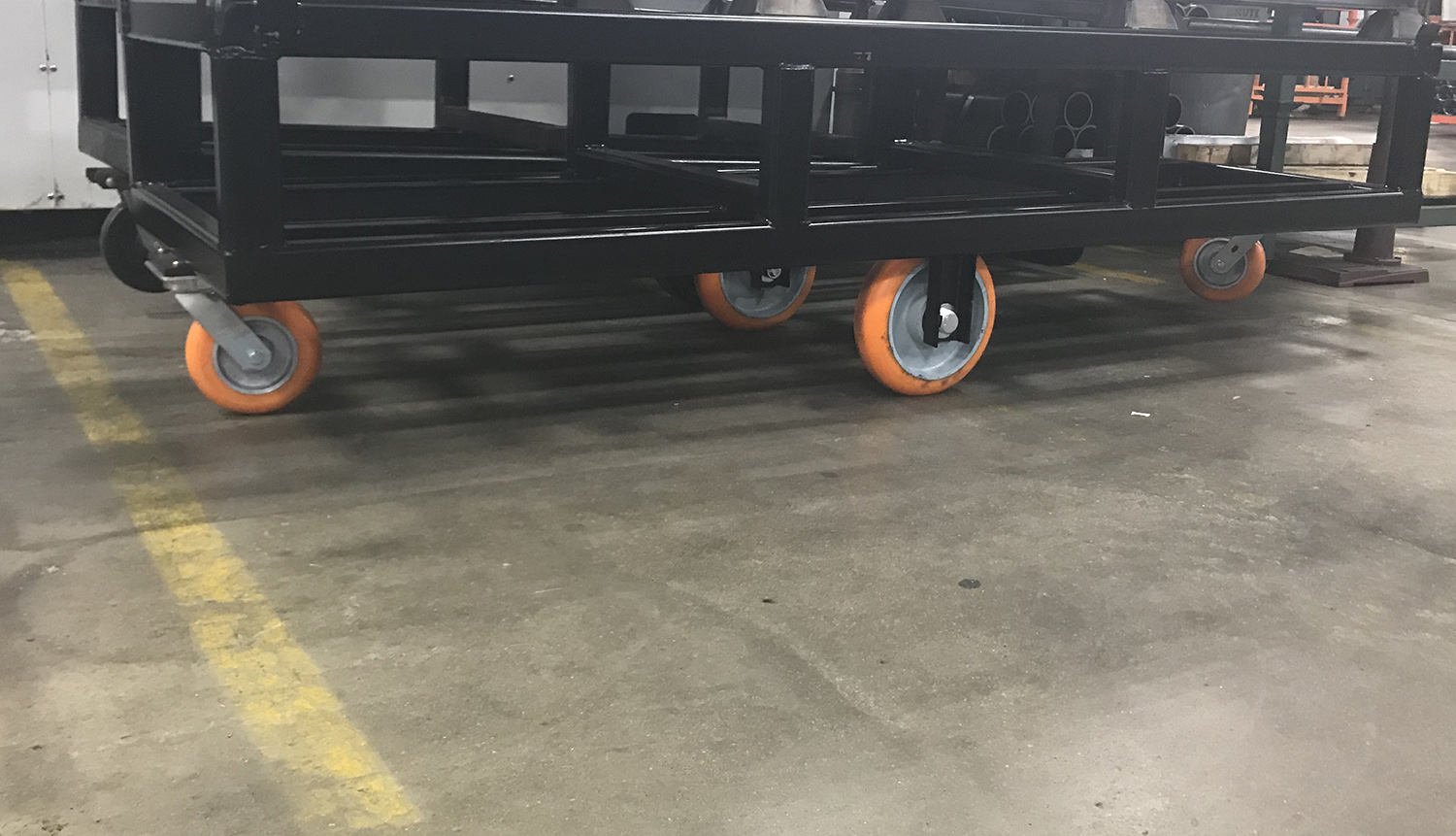
For the industrial-dumpster application, several CC Apex HD characteristics made the product a logical trial candidate.
1. Polyurethane tread for industrial noise reduction
Hard wheels can transmit impacts and floor irregularities into the cart structure. On a large metal dumpster, that energy may become highly audible as vibration resonates through the container.
A resilient polyurethane tread can help moderate this interaction by providing greater cushioning than very hard wheel materials. That makes polyurethane industrial casters a strong candidate for applications where the facility needs to balance:
- Heavy-load capacity
- Rolling performance
- Noise reduction
- Floor protection
- Durability
- Shock and vibration management
This does not mean every polyurethane wheel performs identically. Tread formulation, hardness, wheel diameter, width, core construction and caster rig design all affect performance. The advantage came from selecting a complete caster suited to the application rather than simply replacing one generic wheel with another.
2. Eight-inch wheel diameter
Larger-diameter wheels generally roll more effectively over floor joints, small debris and surface irregularities than smaller wheels. By reducing the severity with which the wheel encounters these obstacles, an appropriately selected larger wheel can support smoother movement and reduce impact-related noise.
The selected CC Apex HD casters used an 8-inch-diameter wheel, providing a strong foundation for demanding indoor industrial mobility.
3. Three-inch wheel width
The 3-inch-wide tread provides a substantial wheel profile for supporting heavy industrial loads. The width also helps distribute the load across a larger contact area than a narrow industrial wheel.
Width alone does not determine rolling performance, but it becomes an important part of a caster system designed for heavy carts, industrial dumpsters and material-handling equipment.
4. Heavy-duty load capacity
Each selected caster carries a published rating of 2,700 pounds. In a four-caster configuration, the arithmetic total of the individual ratings would be 10,800 pounds under ideal conditions.
However, caster systems should not be specified by multiplying the single-caster capacity alone. Real-world conditions may prevent all four casters from sharing the load equally. Floor unevenness, cart deflection, impact, speed, load distribution and operating conditions must all be considered.
The recommendation therefore provided substantial capacity while still emphasizing the importance of application-specific evaluation.
5. Swivel and rigid directional configuration
Using two swivel and two rigid casters is a common configuration for industrial carts that require both turning capability and stable straight-line travel.
For the facility's industrial dumpsters:
- The swivel casters supported directional changes.
- The rigid casters supported tracking and control.
- The combined arrangement avoided the unpredictable movement that may occur when four swivel casters are used on some long or heavy carts.
6. Suitability for heavy manufacturing and logistics
CC Apex HD is designed for heavy-duty applications that may involve manual movement, towlines or automated systems. Caster Connection lists product-performance considerations including ergonomic performance, noise reduction, durability, floor protection and towline performance for the specified caster models.
This broader performance profile made the line relevant to an industrial logistics application in which noise—not merely weight—was the principal problem.
The Trial
Rather than asking the facility to commit immediately to a large-scale caster retrofit, Caster Connection supplied a complete four-caster trial set:
- Two CC Apex HD kingpinless swivel casters
- Two CC Apex HD rigid casters
The casters were installed on one of the facility’s industrial dumpsters so Caterpillar could evaluate the product under actual operating conditions.
This trial-based method was important because industrial noise is highly application-dependent. Relevant variables can include:
- Dumpster construction
- Cart dimensions
- Empty and loaded weight
- Load distribution
- Floor composition
- Floor condition
- Travel route
- Travel speed
- Operator handling
- Debris
- Facility acoustics
- Frequency of movement
A field trial allowed the customer to determine whether the proposed product delivered meaningful improvement in the actual environment where the carts were used.
The Result: Approximately 40 dB Less Cart Noise
During the trial, the facility team reported an approximately 40-decibel reduction in noise from the retrofitted industrial dumpster.
Because the decibel scale is logarithmic, a change of this magnitude represents a major difference in measured sound level. The result should nevertheless be understood as the outcome reported from this particular facility trial, using this cart, route and operating environment. It is not a guaranteed noise reduction for every industrial cart or facility.
The important result was practical and immediately noticeable:
The CC Apex HD retrofit drastically reduced the noise generated by the industrial dumpster as it moved inside the facility.
The trial demonstrated that changing the wheel and caster system could address a problem that might otherwise have been attributed solely to:
- The cart body
- The facility floor
- The load
- Normal industrial activity
- An unavoidable consequence of moving a metal dumpster
Instead of accepting the noise as inherent to the application, the customer and Caster Connection addressed the mobility interface between the dumpster and the floor.
From Successful Trial to Ongoing Retrofit Program
Following the successful trial, the operation began purchasing additional CC Apex HD casters to retrofit more of its industrial dumpsters.
Rather than replacing every caster at once, the facility adopted a progressive purchasing approach, acquiring products approximately one month at a time. This allowed the location to:
- Spread the retrofit across its operating budget
- Prioritize the loudest or most frequently used dumpsters
- Continue validating performance
- Replace existing casters systematically
- Standardize around a proven configuration
- Reduce the operational risk associated with a large untested conversion
The facility has continued purchasing the recommended product for retrofit applications.
This ongoing adoption may be more meaningful than the initial test alone. A trial demonstrates potential. Continued purchasing indicates that the improvement remained valuable enough to expand across additional equipment.
Project Results at a Glance
Before the retrofit
- Industrial dumpsters generated excessive noise inside the facility.
- Existing caster performance was not aligned with the desired acoustic environment.
- Metal cart construction and floor interaction likely amplified rolling sound and vibration.
- The facility needed a heavy-duty caster rather than a light-duty noise-control product.
- A large-scale change had not yet been validated in the real application.
Caster Connection’s approach
- Used a trusted referral from a previous ergonomic caster success.
- Shared relevant industrial noise-reduction case studies.
- Recommended CC Apex HD based on the application.
- Specified two swivel and two rigid 8-inch x 3-inch casters.
- Supplied a complete trial set.
- Allowed the facility to evaluate performance under real operating conditions.
After the retrofit
- The facility reported an approximately 40 dB reduction in cart noise during the trial.
- The facility accepted the recommended CC Apex HD configuration.
- Additional dumpsters began being retrofitted.
- The customer continued purchasing the products incrementally.
- The project established a replicable approach for evaluating noisy mobile equipment at other industrial facilities.
Why Industrial Cart Noise Matters
Noise from material-handling carts is sometimes dismissed as an unavoidable feature of manufacturing, warehousing and industrial logistics. However, excessive rolling noise can signal more than an acoustic inconvenience.
It may indicate:
- Severe impact at floor joints
- Excessive vibration
- Inappropriate wheel hardness
- Wheel damage or tread deterioration
- Loose caster components
- Debris interference
- Poor floor interaction
- A mismatch between the caster and the operating environment
A noisy cart may also affect the broader workplace by contributing to:
- Communication difficulties
- Audible disruption
- Employee fatigue or annoyance
- Increased perceived harshness of material-handling activity
- Vibration transmitted into the load
- Greater wear on carts and caster assemblies
A quieter caster does not automatically resolve every safety, ergonomic or maintenance issue. However, noise can serve as an important symptom that prompts a more comprehensive evaluation of the mobility system.
Applications Beyond Industrial Dumpsters
The principles demonstrated by this project may be relevant to many types of mobile equipment used throughout heavy equipment manufacturing, remanufacturing, logistics and distribution facilities.
Potential applications include:
- Industrial dumpsters
- Scrap carts
- Metal waste containers
- Recycling carts
- Engine transport carts
- Transmission and axle carts
- Component dollies
- Line-side delivery carts
- Kitting carts
- Maintenance carts
- Tooling carts
- Weldment carts
- Heavy parts containers
- Order-picking carts
- Towline carts
- Material-handling racks
- Work-in-process carts
- Mobile assembly fixtures
The same exact caster should not automatically be installed on all these applications. Each cart must be evaluated according to its load, movement, environment and performance requirements.
This project instead provides a model for other heavy equipment facilities:
- Identify the mobility problem.
- Document the current caster and operating conditions.
- Review comparable applications.
- Select a candidate product.
- Conduct a controlled field trial.
- Measure or document the improvement.
- Standardize and expand only after validation.
The Role of a Caster Needs Evaluation
The project reflects the same application-driven philosophy used in Caster Connection’s Caster Needs Evaluation service.
A Caster Needs Evaluation is designed to help facilities identify inefficiencies, safety risks and maintenance concerns within their existing caster setups. Depending on the application, the process may include onsite or virtual consultation, push/pull-force measurements, caster assessment and collaborative planning.
Rather than beginning with a predetermined product, the evaluation begins with the application.
A Caster Needs Evaluation may consider:
The load
- Maximum loaded weight
- Empty cart weight
- Load distribution
- Center of gravity
- Dynamic or impact loading
- Number of casters consistently carrying the load
The movement
- Manual push/pull
- Mechanical towing
- Towline operation
- AGV or AMR movement
- Travel speed
- Distance per cycle
- Turning frequency
- Straight-line tracking requirements
The environment
- Concrete floor condition
- Expansion joints
- Thresholds
- Metal debris
- Oil and moisture
- Chemicals
- Washdown requirements
- Temperature
- Indoor noise sensitivity
The existing problem
- Excessive noise
- Difficult startup
- High turning force
- Poor tracking
- Wheel damage
- Caster failure
- Floor damage
- Vibration
- Frequent replacement
- Maintenance demands
The required outcome
- Quieter movement
- Reduced push/pull force
- Better maneuverability
- Greater load capacity
- Improved durability
- Longer caster life
- Increased towline performance
- Lower maintenance
- Better floor protection
Caster Connection offers onsite, in-person and virtual evaluation options and describes the service as a way to create a customized caster plan for concerns including ergonomics, automation and lean manufacturing.
Lessons for Other Heavy Equipment Facilities
1. Do not assume industrial cart noise is unavoidable
The cart may not need to be completely redesigned. A properly selected caster retrofit may produce a substantial improvement.
2. Evaluate wheel material, not only load capacity
A wheel that supports the load may still create excessive vibration, noise or floor impact.
3. Test the complete caster configuration
Wheel tread, wheel diameter, wheel width, bearings, swivel design and rigid-caster placement all influence performance.
4. Conduct a facility trial before a fleetwide conversion
A four-caster trial can provide meaningful application evidence while limiting upfront risk.
5. Use measurable results where possible
Noise readings, push/pull-force measurements, maintenance records and replacement history help turn a subjective complaint into a documented improvement opportunity.
6. Retrofit progressively
Once the configuration is validated, casters can be replaced by department, equipment priority, maintenance cycle or monthly budget.
7. Share successful applications across locations
A solution validated in one heavy equipment facility may provide a useful starting point for similar applications elsewhere, provided each location’s operating conditions are reviewed.
Conclusion
The heavy equipment logistics project began with a focused but disruptive problem: industrial dumpsters were too loud when moved inside the facility.
Through a referral from an earlier ergonomic caster success, Caster Connection introduced the facility to comparable noise-reduction applications and recommended a heavy-duty CC Apex HD caster configuration.
A trial set of two swivel and two rigid casters produced a reported reduction of approximately 40 dB. Following the trial, the facility began an ongoing program of purchasing additional casters to retrofit more industrial dumpsters.
The project demonstrates an important principle for heavy equipment manufacturing, industrial logistics, warehousing and material handling:
Caster selection should address how equipment performs, not simply how much weight it can carry.
By evaluating the load, floor, cart, movement and desired outcome together, industrial facilities can identify mobility improvements that support quieter operation, smoother material flow and more effective long-term caster performance.
Request a Caster Needs Evaluation
Turn Persistent Mobility Problems into Measurable Improvements
Are noisy carts, excessive push/pull forces, premature caster failures or difficult material-handling equipment affecting your facility?
Caster Connection can evaluate your existing caster setup, document application conditions and recommend products based on the way your equipment actually operates.
Request a free Caster Needs Evaluation to begin evaluating your facility’s industrial carts, dumpsters, towlines, workstations and material-handling equipment.
